


Solar panels are available in several designs, each developed to convert sunlight into electricity using different materials and manufacturing techniques. The three primary categories are monocrystalline, polycrystalline, and thin-film solar panels. Although they share the same fundamental purpose, they differ in energy conversion efficiency, physical appearance, production costs, and installation requirements.
Understanding these differences can help homeowners and businesses identify a solar technology that fits their available space, electricity consumption, and project budget.
Types of Solar Panels
Solar panels are primarily classified into three types: monocrystalline, polycrystalline, and thin-film. Each technology offers a different balance of efficiency, affordability, and design flexibility. Selecting the right option requires considering the conditions of the installation site and the amount of electricity the system needs to produce.
The table below summarizes the primary advantages and limitations of each type.
| Solar Panel Type | Advantages | Disadvantages |
| Monocrystalline | High efficiency, strong power output, sleek appearance | Generally higher purchase price |
| Polycrystalline | More affordable manufacturing and purchase costs | Usually less efficient than monocrystalline panels |
| Thin-film | Lightweight construction, flexible designs, low-profile appearance | Generally lower efficiency and greater space requirements |
The following sections explore how these solar technologies are manufactured, what distinguishes their appearance, and how their performance and costs compare.
Which Materials Are Used in Solar Panel Production?
Solar panels generate electricity through photovoltaic cells, which absorb sunlight and convert its energy into electrical current. These cells contain semiconductor materials that respond to incoming light by releasing electrons, allowing an electric current to flow through an electrical circuit.
Silicon is widely used in photovoltaic manufacturing because of its ability to convert sunlight into electricity. However, solar technology is not limited to silicon-based cells. Certain panel designs use other semiconductor compounds, which influence their physical properties, production methods, and energy conversion performance.
The materials selected for a solar panel also affect its durability, weight, appearance, and suitability for particular installation environments.
Monocrystalline and Polycrystalline Solar Panels

Monocrystalline and polycrystalline panels both rely on silicon-based photovoltaic cells. In conventional crystalline silicon modules, these cells are connected electrically and arranged in a grid before being enclosed beneath protective glass and secured within a supporting frame.
The principal difference between the two technologies lies in the crystalline structure of their silicon.
Monocrystalline cells are manufactured from silicon with a continuous crystal structure. Producing this material involves forming individual silicon crystals, which are subsequently processed into thin wafers for solar cell manufacturing.
Polycrystalline cells, by comparison, are produced using silicon that solidifies into multiple interconnected crystals. The resulting material is cut into wafers and processed into photovoltaic cells.
These different manufacturing methods influence the appearance, efficiency, and production costs of the finished panels. Monocrystalline technology generally achieves higher efficiency, whereas polycrystalline technology has historically offered a more economical alternative.
Thin-Film Solar Panels
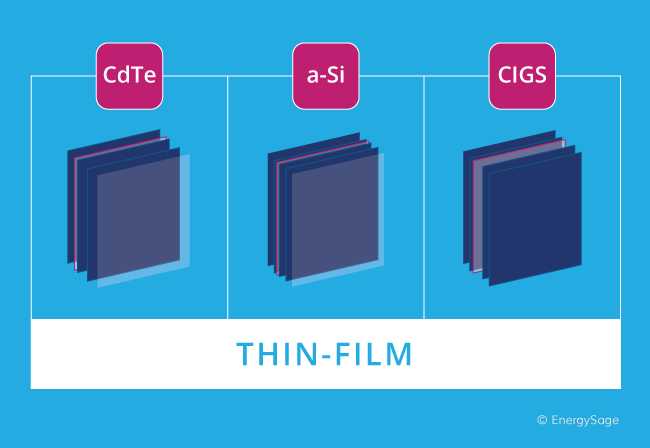
Thin-film solar panels use a different manufacturing approach from conventional crystalline silicon modules. Instead of relying on relatively thick silicon wafers, this technology deposits extremely thin layers of photovoltaic materials onto suitable supporting surfaces.
Several semiconductor materials can be used to manufacture thin-film cells, with cadmium telluride (CdTe), amorphous silicon (a-Si), and copper indium gallium selenide (CIGS) representing three established technologies.
Cadmium telluride (CdTe) panels use a thin semiconductor layer that absorbs sunlight and converts it into electricity. The photovoltaic material is deposited onto a supporting substrate and incorporated into a module with the necessary electrical contacts and protective layers.
Amorphous silicon (a-Si) panels also rely on silicon, but the material does not have the regular crystalline structure found in conventional monocrystalline and polycrystalline cells. Instead, silicon is deposited in a non-crystalline form onto a substrate, which may consist of glass, plastic, or metal. This approach allows manufacturers to produce thin photovoltaic layers without creating traditional silicon wafers.
Copper indium gallium selenide (CIGS) technology combines copper, indium, gallium, and selenium to create a light-absorbing semiconductor layer. This material is deposited onto a suitable substrate and integrated with conductive layers that collect the electricity generated by the cells.
The precise construction of a thin-film module depends on its technology and intended application. Some products are designed for conventional framed installations, while others are manufactured to be lightweight, flexible, or suitable for specialized surfaces.
What Do Different Types of Solar Panels Look Like?
The materials and manufacturing techniques used in solar panels affect their visual characteristics. Differences in cell color, surface texture, thickness, and frame design can help distinguish one technology from another.
Monocrystalline Solar Panels
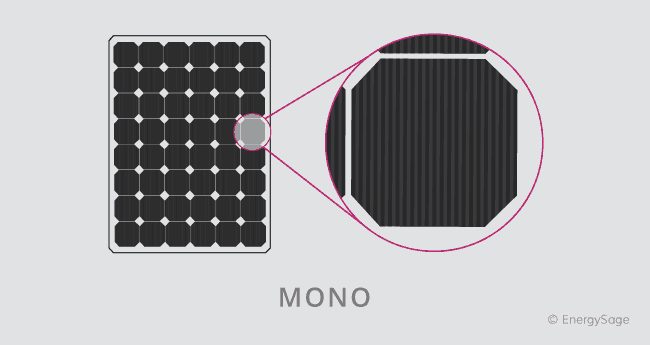
Monocrystalline panels typically feature dark black or nearly black photovoltaic cells. Their appearance results from the optical properties of the crystalline silicon and the way the cell surface is designed to absorb sunlight.
The finished module may have a black, silver, or white backsheet, depending on the manufacturer’s design. Its frame is commonly made from metal and is often finished in black or silver.
Black-framed modules with dark cells are frequently selected for residential installations because they create a relatively uniform appearance on rooftops. However, the exact design varies between manufacturers and product models.
Polycrystalline Solar Panels
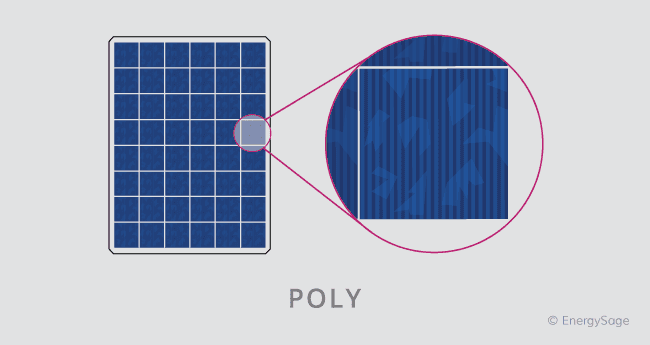
Polycrystalline panels are commonly recognized by their blue cells, which often display a visible, irregular crystalline pattern. This appearance reflects the material’s multiple-crystal structure and the way light interacts with its surface.
Their supporting frames are frequently silver, although other finishes may be available. The backsheet is typically white or another manufacturer-selected color.
Compared with the more uniform appearance of many monocrystalline modules, polycrystalline panels tend to have a more visibly textured surface. Their appearance may be an important consideration when selecting panels for buildings where rooftop aesthetics matter.
Thin-Film Solar Panels
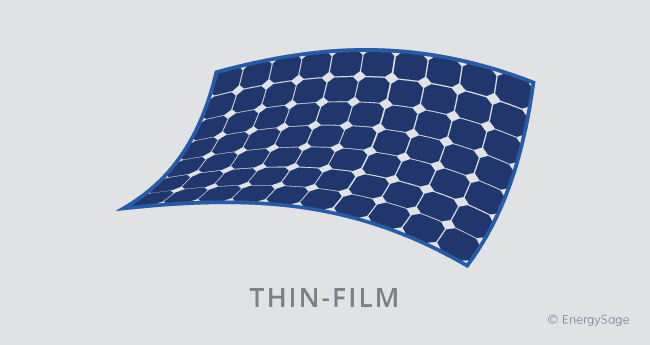
Thin-film panels are characterized by their thin photovoltaic layers and the variety of module designs that can be produced using this technology.
Certain products have a smooth, low-profile appearance, while others resemble conventional framed solar panels. Some specialized models can also be manufactured as flexible sheets, making them suitable for applications where rigid modules may be impractical.
It is important to distinguish between the thickness of the photovoltaic material and the overall dimensions of the finished product. Although the active semiconductor layers are much thinner than conventional crystalline silicon wafers, the protective materials, substrate, and frame can increase the total module thickness.
The color of thin-film panels varies according to their semiconductor composition and surface treatment. Depending on the technology, their appearance may range from dark black to blue or other shades.
Solar Panel Efficiency and Power Output
Solar panel efficiency describes the proportion of incoming sunlight that a panel converts into electricity under specified testing conditions. Power output, measured in watts (W), indicates the electrical power a module can deliver under those conditions.
Both measurements are important when comparing solar panels. A more efficient panel can generally produce more electricity from a given amount of roof space, while a higher-wattage module may reduce the number of panels required to achieve a particular system capacity.
Actual electricity generation also depends on factors such as sunlight exposure, temperature, shading, orientation, and installation conditions.
Monocrystalline and Polycrystalline Solar Panels
Monocrystalline panels generally achieve higher conversion efficiency than traditional polycrystalline modules. Depending on the specific product and generation of technology, monocrystalline modules can exceed 20% efficiency, while conventional polycrystalline products have historically delivered efficiencies of approximately 15% to 17%.
These figures are indicative rather than universal specifications. Actual performance varies by manufacturer, model, and production technology.
Monocrystalline panels are also available in a broad range of power ratings. Some models exceed 400 W, although the available output depends on module dimensions, cell technology, and product design. Polycrystalline modules have historically tended to offer lower power ratings than comparable modern monocrystalline products.
However, a panel’s wattage should not be evaluated independently of its physical size. A larger module may produce more total power simply because it has a greater surface area.
Both crystalline technologies have been manufactured in different cell arrangements and module dimensions. Traditional configurations included 60-cell and 72-cell modules, while some products used 96-cell layouts. Modern module designs have evolved, so cell counts alone are no longer a reliable way to compare the power output of different products.
For property owners working with limited roof space, the higher efficiency often available from monocrystalline panels can be particularly beneficial.
Thin-Film Solar Panels
Thin-film panels generally have lower efficiency than conventional crystalline silicon modules, although the exact performance depends on the semiconductor material and the specific product. Some thin-film technologies have historically operated at efficiencies around 11%, but this should not be treated as a fixed figure for every thin-film module.
Their physical dimensions also vary considerably because thin-film products are not restricted to the same conventional cell and module configurations used by traditional crystalline panels.
Consequently, the power output of a thin-film module depends on its technology, dimensions, and design. A larger module may produce more electricity than a smaller one, even when both use the same photovoltaic technology.
When comparing power generation per unit of roof area, monocrystalline panels will generally have an advantage over many thin-film products. Nevertheless, thin-film technology may remain suitable for applications where low weight, flexibility, or specialized installation requirements are more important than maximizing output from a limited surface area.
Solar Panel Costs
The price of a solar panel depends on more than its photovoltaic material. Manufacturing complexity, module efficiency, product availability, and production scale can all influence the final cost.
Installation expenses should also be considered when comparing technologies. Mounting equipment, electrical components, labor, and any structural modifications can affect the total project budget.
Monocrystalline Solar Panels
Monocrystalline panels have traditionally been more expensive to manufacture than polycrystalline alternatives because producing high-quality single-crystal silicon requires additional processing.
One established technique for growing silicon crystals is the Czochralski process. During this process, a seed crystal is used to grow a larger silicon crystal from molten material. The resulting crystal can then be processed into wafers for photovoltaic cell production.
Growing and processing these crystals requires energy and specialized equipment. Cutting the crystals into wafers also produces silicon offcuts and other manufacturing waste, some of which may be recovered or reused.
These production requirements have historically contributed to the higher manufacturing costs of monocrystalline cells. However, improvements in production methods and manufacturing scale have changed the economics of solar technology over time. Therefore, actual prices should be compared using current product specifications and supplier quotations rather than assumptions based solely on panel type.
Polycrystalline Solar Panels
Polycrystalline technology was developed partly as a lower-cost alternative to conventional monocrystalline manufacturing.
Because the silicon forms multiple crystals during solidification, manufacturers do not need to produce the same type of single-crystal material required for monocrystalline cells. This difference can simplify certain stages of the manufacturing process and reduce production costs.
Polycrystalline panels have therefore historically occupied a more affordable position in the market. However, their cost advantage should be evaluated in the context of current availability and pricing.
As photovoltaic manufacturing technology has advanced, monocrystalline products have become increasingly competitive. In some markets, polycrystalline modules are now less widely available, making it important to compare actual quotations rather than assume they will always be the cheaper option.
Thin-Film Solar Panels
The production cost of thin-film panels varies according to the semiconductor material, manufacturing process, and intended application.
CdTe technology has historically been associated with relatively economical large-scale manufacturing. Amorphous silicon can also be produced using thin-film deposition techniques, while CIGS manufacturing involves a different combination of materials and processing requirements. The relative cost of these technologies depends on production scale, equipment, material usage, and product specifications.
Thin-film systems may offer installation advantages in certain circumstances. Lightweight modules can reduce handling difficulties, while specialized designs may require less conventional mounting equipment.
These characteristics can help lower installation expenses when the project is compatible with the selected product. However, the savings are not guaranteed. Some thin-film installations require specialized mounting methods, additional electrical components, or a larger installation area.
For this reason, the total installed cost should be evaluated alongside expected electricity generation, available roof space, and the system’s intended service life.
Which Type of Solar Panel Is Best for Your Installation?
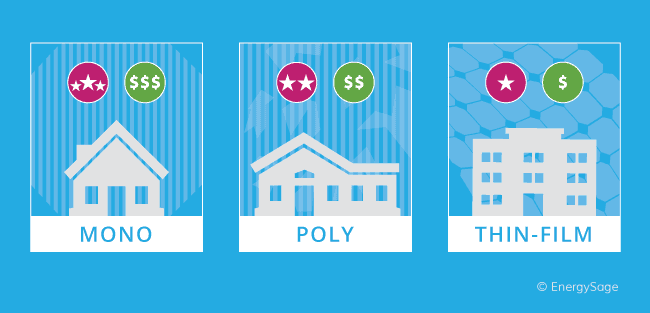
The most appropriate solar panel technology depends on the building, installation conditions, available budget, and expected electricity demand. No single type is automatically the best choice for every project.
Monocrystalline panels are often a practical choice when roof space is limited. Their relatively high efficiency allows property owners to generate more electricity from a given area. They may be particularly suitable for homes and commercial buildings where maximizing energy production from the available roof surface is a priority.
Polycrystalline panels may be worth considering when initial equipment costs are a priority. Their lower efficiency means that more surface area may be required to achieve the same power capacity as a higher-efficiency system. However, their suitability depends on current market availability, actual pricing, and the space available for installation.
Thin-film panels can be useful for installations with specialized requirements. For example, certain lightweight products may be suitable for large commercial rooftops where structural load limitations affect the choice of solar equipment. Before selecting this technology, the roof’s load capacity, mounting requirements, and the manufacturer’s installation specifications should be assessed.
Thin-film technology may also be appropriate for portable solar power applications, including some recreational vehicles (RVs) and boats. Flexible or lightweight modules can be advantageous in these settings, provided the selected product is designed for the relevant operating environment.
For commercial and industrial properties, it is important to evaluate the roof structure, usable installation area, electricity consumption profile, and expected project economics before selecting a technology. You can explore potential solutions for commercial and industrial solar panel installations to better understand the options available for larger properties.
Ultimately, choosing a solar panel should involve more than comparing efficiency ratings or purchase prices. Evaluating expected electricity production, total installation costs, available space, and long-term operating requirements will provide a more reliable basis for making a decision.