

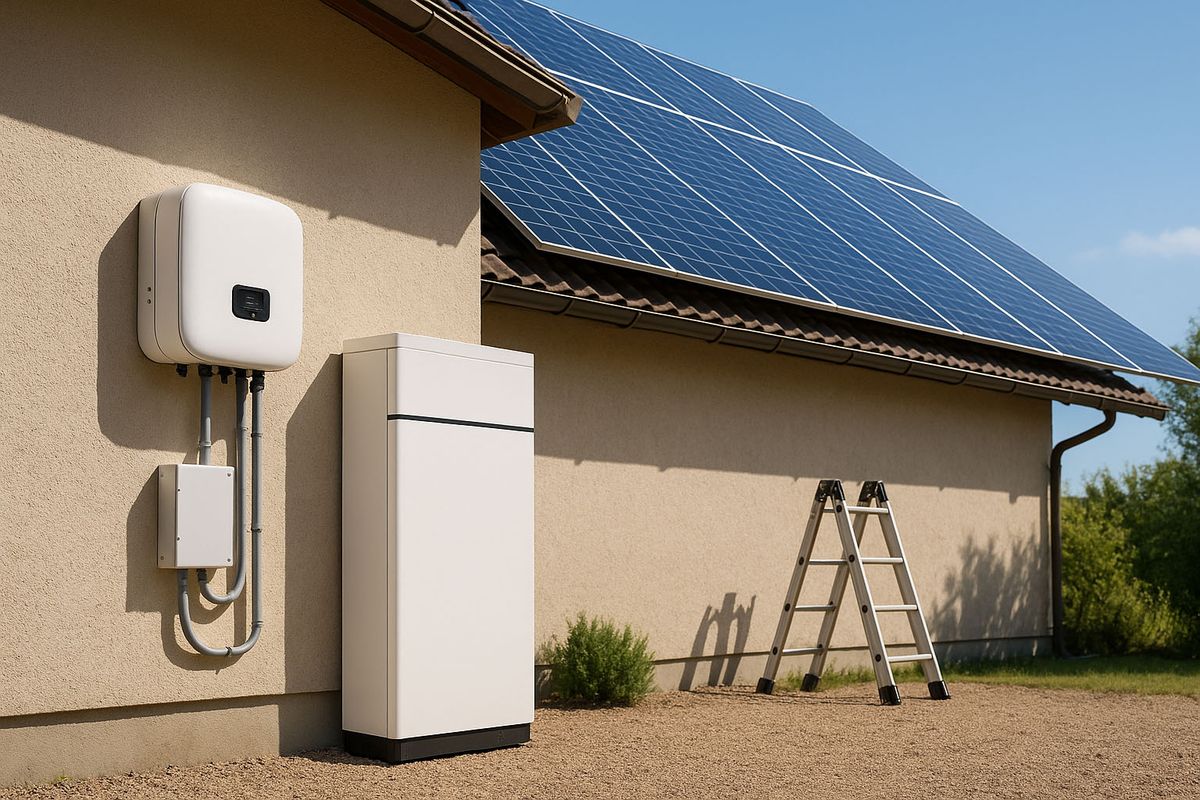
In a hybrid solar PV system, the battery plays a key role in storing solar energy that isn’t used right away during the day. That stored energy can then power your home at night, on cloudy days, or during a grid outage.
For the system to work at its best, your solar panel battery capacity needs to match your electricity needs. Too little capacity and your backup runs out quickly; too much and your investment balloons without a matching benefit. This guide explains how to determine the right solar battery capacity for both homes and businesses.
What Is a Lithium Battery for a Hybrid PV System?
A lithium battery is a rechargeable battery that uses lithium compounds as its main energy storage material. For solar PV systems, the most widely used type is lithium iron phosphate (LiFePO4), thanks to its stability, safety, and long cycle life compared with lead-acid batteries.
In a hybrid PV system, the battery works alongside the solar panels, a hybrid inverter, and the PLN grid. When solar production exceeds demand, the surplus energy is stored in the battery. When production falls short, such as at night or on cloudy days, the battery supplies the stored energy to run your loads. This reduces your reliance on grid power and keeps essential loads running during outages.
Factors That Determine Battery Capacity
Before doing a PV battery capacity calculation, it’s important to understand the following factors:
- Total daily energy consumption. The amount of energy you use per day (kWh) is the foundation of the calculation. You can find this on your electricity bill or usage history.
- Loads the battery needs to support. Decide whether the battery will power your entire load or only essentials such as lights, the refrigerator, the router, and the water pump.
- Required backup time. The longer the loads need to run without solar or grid power, the more battery capacity you’ll need.
- PV system and hybrid inverter capacity. The solar panels must be able to fully charge the battery, while the hybrid inverter must support the battery’s voltage, charging current, and output power.
- Battery Depth of Discharge (DoD). DoD indicates the percentage of battery capacity that can be used safely. LiFePO4 batteries typically have a DoD of around 80–95%, far higher than lead-acid batteries at about 50%.
- Electricity usage conditions and patterns. A home that uses a lot of power at night will naturally need more storage than a building whose main loads run during the day.
How to Calculate Lithium Battery Capacity
Here’s a simple PV battery capacity calculation you can use as a starting point:
Step 1: Calculate your daily energy needs. Add up the consumption of each appliance using the formula power (watts) × hours of use. For example, a 100 W refrigerator running for 24 hours uses about 2.4 kWh per day.
Step 2: Decide how much energy needs to be stored. Not all of your daily energy needs to be stored. Focus on the energy used when the panels aren’t producing, for example from evening to morning, or on essential loads that must stay on during outages.
Step 3: Adjust for DoD and battery efficiency. Divide the energy you need to store by the DoD and system efficiency. The simple formula is: battery capacity = energy required ÷ (DoD × efficiency).
Step 4: Set the capacity based on your backup needs. If the battery needs to support the load for more than one night, multiply the result by the number of backup days, then round up to the nearest battery module size available on the market.
Example calculation for a home. A home uses about 4 kWh of electricity between 6 p.m. and 6 a.m. With a DoD of 90% and 95% efficiency, the required capacity is 4 ÷ (0.9 × 0.95) ≈ 4.7 kWh. A 51.2 V 100 Ah lithium battery (about 5.1 kWh) is enough to cover this.
Example calculation for a business. A small office needs about 20 kWh of backup for its server, air conditioning, and lighting. Using the same assumptions, the required capacity is 20 ÷ (0.9 × 0.95) ≈ 23.4 kWh, which can be met with five 5.1 kWh battery modules connected in parallel (about 25.6 kWh).
Battery Capacity Examples for Different Needs
As a rough guide, here are estimated battery capacities for different types of needs:
Light electricity needs. To support basic loads such as lights, a router, and phone charging of about 1–2 kWh, a battery of around 2.5 kWh is usually enough.
Households with nighttime usage. Homes that run a refrigerator, TV, fans, or an air conditioner at night typically need around 5–10 kWh of battery storage, depending on the number of appliances and how long they’re used.
Business needs or facilities with heavier loads. Shops, offices, clinics, and other business facilities usually need anywhere from a dozen to several dozen kWh. At this scale, the calculation should be based on a more detailed load profile.
Using multiple batteries in parallel. Larger capacities can be achieved by connecting several battery modules in parallel. Make sure the modules share the same brand, type, voltage, and condition, and that their BMS units can communicate with each other to keep charging and discharging balanced.
Tips for Choosing a Lithium Battery for a Hybrid PV System
Beyond capacity, keep the following in mind when choosing a lithium battery for a hybrid solar PV system:
- Make sure it’s compatible with your hybrid inverter. Match the battery voltage (for example 48 V/51.2 V or high voltage) and communication protocols such as CAN or RS485 to the inverter’s specifications.
- Look at capacity and DoD. Compare the usable capacity, not just the nominal capacity printed on the label.
- Check the Battery Management System (BMS). The BMS protects the battery from overcharging, over-discharging, overcurrent, and extreme temperatures.
- Consider the battery’s cycle life. Quality LiFePO4 batteries typically last thousands of charge cycles. The longer the cycle life, the lower your long-term cost of energy storage.
- Choose a battery with solid safety and monitoring features. Monitoring through an app or display makes it easy to check the battery’s condition, remaining capacity, and usage history.
- Think about future expansion. Choose a modular system that lets you add batteries as your electricity needs grow.
FAQ: Lithium Battery Capacity for Hybrid PV Systems
How long can a lithium battery store energy from solar panels?
Lithium batteries have a low self-discharge rate, so energy can stay stored for quite a while when the battery isn’t in use. In a hybrid PV system, however, stored energy is usually used the same night and recharged the next day.
Does battery capacity have to match solar panel capacity?
No. Solar panel capacity is measured in kWp (peak power), while battery capacity is measured in kWh (stored energy). What matters is that daily solar production is enough to cover daytime loads and fully charge the battery.
Can lithium batteries be used with any hybrid inverter?
Not always. The battery must match the inverter’s voltage range, charging current, and communication protocol. Check the inverter manufacturer’s list of supported batteries or consult your PV provider before buying.
When is the best time to use stored battery energy?
Battery energy is most useful when the panels aren’t producing, such as from late afternoon into the night, on cloudy days, or during power outages. These priorities can be set through the hybrid inverter’s operating modes.
Can lithium battery capacity be expanded after the PV system is installed?
Yes, especially if the system uses modular batteries and the inverter supports additional capacity. It’s best to use modules of the same brand and type, and make sure your solar panel capacity is enough to charge the extra batteries.
Choosing the right solar panel battery capacity isn’t just about picking the biggest size. Lithium battery capacity should be matched to your energy consumption, backup needs, PV capacity, inverter, and the battery’s DoD. Getting the calculation right helps you avoid both an undersized battery and an oversized investment. Choosing a battery that’s compatible and expandable is also key for a hybrid PV system built for the long term.
Still not sure what battery capacity is right for your home or business? The ATW Solar team is ready to help, from consultation and energy needs assessment to designing a complete hybrid PV system with the right lithium battery.