

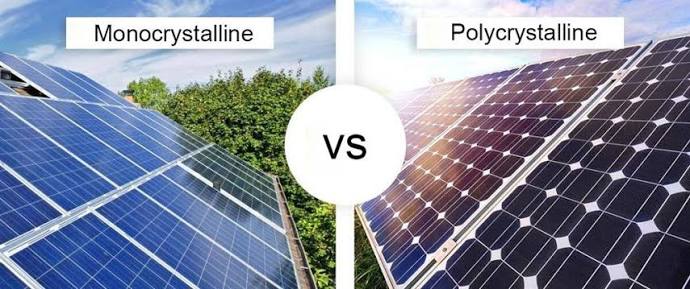
If you’ve ever looked at rows of solar panels on a house or factory roof, you may have noticed that they don’t all look the same. Some are a deep, uniform black, while others are bluish with a speckled, crystal-like pattern. That difference in color isn’t just a design choice. It reflects two different cell technologies: monocrystalline solar panels and polycrystalline solar panels.
Both types are made from silicon and have been used in solar PV systems for many years. Even so, they differ in their physical characteristics, efficiency, and the space they need. Understanding how monocrystalline vs polycrystalline solar panels compare will help you choose the type that best fits your PV system.
What Are Monocrystalline and Polycrystalline Solar Panels?
Monocrystalline panels use solar cells cut from a single, continuous silicon crystal. Because the crystal structure is uniform, electrons can move more freely within the cell, making the conversion of light into electricity more effective.
Polycrystalline panels use cells made from many small silicon crystals fused together. The boundaries between these crystals slightly hinder the flow of electrons, so their efficiency is generally lower than that of monocrystalline panels.
The difference starts in the manufacturing process. Silicon for monocrystalline cells is slowly grown into a single cylindrical crystal ingot, which is then sliced into thin wafers. Silicon for polycrystalline cells, on the other hand, is melted, poured into a mold, and cooled into blocks, which are then cut into square wafers. This casting process is simpler and produces less waste, which keeps production costs lower.
Physical Differences Between Monocrystalline and Polycrystalline
The two panel types are fairly easy to tell apart at a glance. Here are their main physical features:
- Color and surface appearance. Monocrystalline panels are usually a uniform deep black, giving them a cleaner look on the roof. Polycrystalline panels are blue with a glittery, flake-like pattern, caused by the many crystals reflecting light at different angles.
- Cell shape and layout. Older monocrystalline cells have clipped corners, leaving small diamond-shaped gaps between them, although many modern panels now use full-square cells. Polycrystalline cells are perfectly square and fit tightly together with no corner gaps.
- Size and space usage. Because they’re more efficient, monocrystalline panels can deliver the same output with fewer panels. Polycrystalline panels need more area to reach the same capacity.
- Material characteristics. Monocrystalline panels use silicon with high purity and a highly ordered structure. Polycrystalline panels use more affordable multicrystalline silicon, but with a less uniform structure.
Solar Panel Performance Compared
Beyond appearance, the most important differences lie in performance. Here’s how they compare:
Efficiency. Modern monocrystalline panels typically reach module efficiencies of around 20–23%, while polycrystalline panels fall in the 15–18% range. In other words, from the same amount of light, monocrystalline panels convert more energy into electricity.
Performance under varying light. In the morning, late afternoon, or cloudy weather, monocrystalline panels tend to perform slightly better. The difference isn’t large, but over a full year, the extra output adds up.
Effect of temperature. All solar panels lose some output as they heat up, measured by the temperature coefficient. The latest monocrystalline panels typically have a coefficient of around -0.30 to -0.35% per °C, compared with about -0.40% per °C for polycrystalline. In a tropical climate like Indonesia’s, this gap makes monocrystalline panels more stable on hot, sunny afternoons.
Power from the same installation area. As an example, a 20 m² roof fitted with 21%-efficient panels can hold about 4.2 kWp. With 16%-efficient panels, capacity drops to around 3.2 kWp. That difference of roughly 1 kWp is significant for home roofs with limited space.
Pros and Cons of Each Panel Type
Here’s a summary of the pros and cons of monocrystalline solar panels:
- Higher efficiency, so each panel produces more electricity.
- Better suited to limited space, ideal for homes or buildings with a small installation area.
- Generally more expensive per panel, although the price gap keeps narrowing thanks to mass production.
Meanwhile, here are the pros and cons of polycrystalline solar panels:
- More budget-friendly thanks to a simpler production process.
- Suitable for larger installation areas, such as open land or spacious warehouse roofs.
- Generally lower efficiency than monocrystalline, so more panels are needed for the same capacity.
Which One Is Right for Your Solar PV System?
Your choice of panel should be based on the project’s conditions, not just the price per panel. Here are a few points to guide you:
- Consider the installation area. If the roof is small or split into several sections, monocrystalline panels help you make the most of the available space.
- Match your power needs. Work out your daily energy needs first, then compare how many panels of each type you would need.
- Mind your investment budget. Compare the cost per installed kWp and the projected long-term energy output, not just the price per panel.
- Consider site conditions and intended use. For hot locations or buildings where looks matter, monocrystalline is usually the better choice. For large-scale land-based projects on a tight budget, polycrystalline can still be an option where available.
FAQ: Monocrystalline vs Polycrystalline Solar Panels
Do monocrystalline panels last longer than polycrystalline panels?
Both can last more than 25 years when properly installed and maintained. Modern monocrystalline panels generally degrade slightly more slowly each year, and many manufacturers offer performance warranties of up to 25–30 years.
Does panel color affect performance?
Color simply results from the crystal structure and the anti-reflective coating on the cells. The dark color of monocrystalline panels indicates a uniform crystal structure, but performance still depends on cell efficiency, material quality, and the overall panel design.
Can both panel types be used in the same PV system?
Yes, as long as they aren’t combined in the same string or on the same MPPT input. Because their voltage and current characteristics differ, each type should be connected to a separate MPPT input or a different inverter.
How does temperature affect the performance of each type?
As panel temperature rises, cell voltage drops, reducing power output. Monocrystalline panels usually have a better temperature coefficient, so they lose less output on hot afternoons than polycrystalline panels.
Are polycrystalline panels still relevant for today’s PV installations?
Polycrystalline’s market share has shrunk considerably as monocrystalline panels have become more affordable. Even so, polycrystalline panels can still work for projects with large areas and limited budgets, provided product availability and warranties are assured.
Comparing monocrystalline vs polycrystalline solar panels shows that they differ in appearance, cell technology, efficiency, and cost. Monocrystalline panels lead in efficiency and heat tolerance, while polycrystalline panels offer a more economical option for large areas. No single choice is best for every installation, so your panel selection should be based on your power needs, available area, site conditions, and project budget.
Not sure which panel type is the best fit for your roof or land? The ATW Solar team is ready to help, from site surveys and capacity calculations to panel selection and optimal PV system design.