

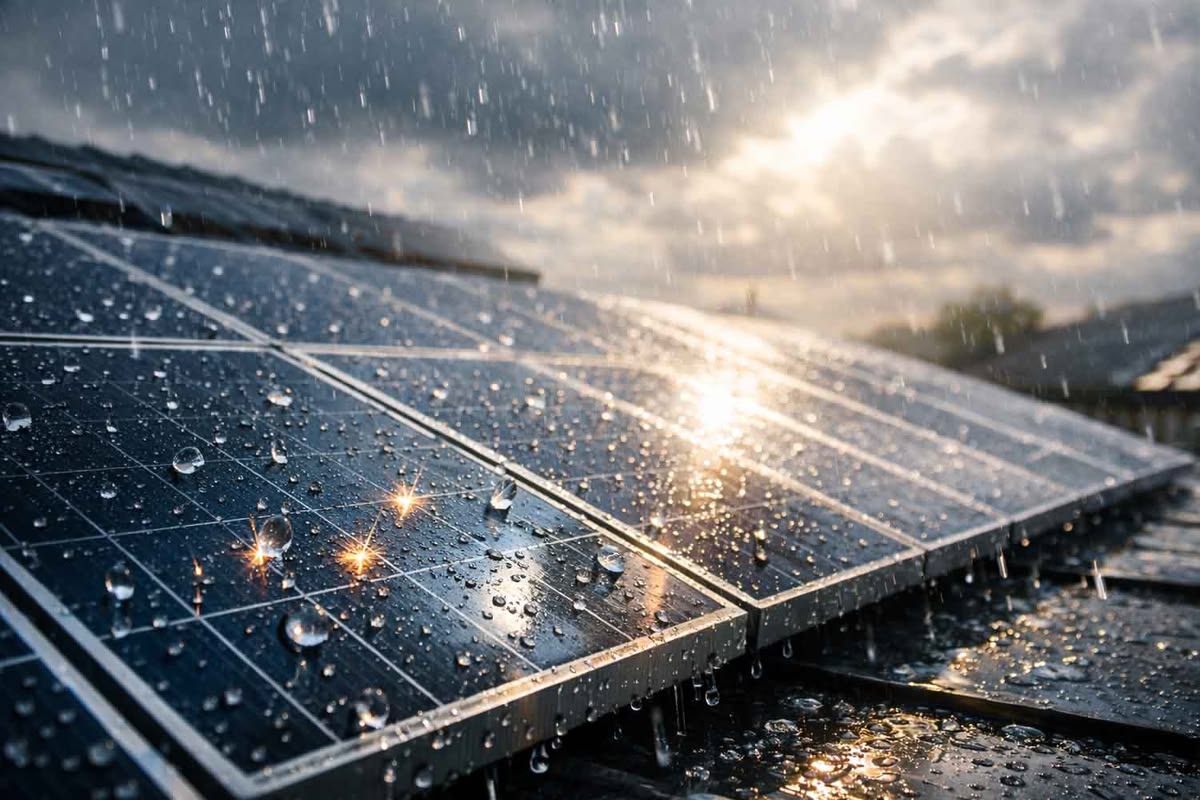
A number of myths persist around solar panels, from the belief that they can be damaged by water to the assumption that they are useless whenever the sky turns cloudy. So, what actually happens if solar panels get rained on? Do solar panels still generate electricity when the weather isn’t sunny?
Understanding how solar panels perform under different weather conditions matters, especially for prospective users living in a tropical country like Indonesia, where rainfall is fairly heavy throughout the year.
What Happens If Solar Panels Get Rained On?
Solar panels are, in fact, safe to be exposed to rainwater. They are built to be installed outdoors and to withstand a wide range of weather conditions year-round, so rainwater does not seep into the solar cells or the electrical components inside. This safety is backed by the materials and protective standards built into every layer of the panel. A typical solar panel consists of a tempered glass layer on the front, solar cells encased in an encapsulant material (EVA), a waterproof backsheet on the rear, and a sturdy aluminum frame. The junction box, where the cables exit the panel, is generally rated IP65 or IP67, meaning it is fully protected against dust and can withstand splashing or a certain degree of submersion without leaking. This is what allows solar panels to hold up against rain, dew, and high humidity, provided the installation follows proper technical standards.
So, can rain damage solar panels? Generally speaking, ordinary rain will not damage solar panels as long as the installation is carried out correctly by a professional installer using certified components. The real concern isn’t the rain itself, but other risks such as a direct lightning strike or large hailstones, which could crack the glass surface. These risks can be minimized through a proper grounding system and surge protection built into the PLTS installation.
Do Solar Panels Still Work on Cloudy Days?
A common misconception is that solar panels need the sun’s heat to operate. In reality, solar panels generate electricity through the photovoltaic process, which converts light (photons) into electrical energy, not heat. This means that as long as light still reaches the panel’s surface, even under a cloudy sky, the solar cells can continue generating electricity.
That said, electricity output does drop on cloudy days compared to sunny conditions. This happens because thick clouds block a portion of the sunlight intensity that reaches the panel’s surface, reducing the number of photons available for conversion into electricity. The thicker the clouds and the darker the sky, the greater the drop in output. Beyond cloud cover, several other factors also affect a solar panel’s performance, including the panel’s tilt angle and orientation, how clean its surface is, ambient temperature, the quality of components such as the inverter, and whether or not the installation area is shaded by nearby buildings or trees.
Can Rain Help Clean Solar Panels?
One upside of rain is that it naturally helps wash away dust, particles, and light debris that settle on a solar panel’s surface. As rainwater runs down the glass, it acts much like a simple rinsing process, helping to keep the panel’s surface reasonably free of daily dust buildup.
Even so, rain alone isn’t always enough to keep a panel optimally clean, particularly against stubborn residue such as bird droppings, tree sap, soot, or hardened dirt that clings firmly to the surface. In these cases, periodic manual cleaning is still necessary to keep performance at its best, since accumulated dust and grime can block the sunlight that solar cells are meant to absorb, gradually lowering electricity output. That’s why combining rain’s natural cleaning effect with regular manual maintenance is key to keeping a solar panel’s performance at its peak year-round.
How to Maximize Solar Panel Performance During the Rainy Season
The first important step is choosing high-quality solar panels from a trusted manufacturer with internationally certified standards, such as an appropriate IP rating and weather-resistance testing. Higher-quality panels are generally more resistant to humidity, extreme temperature swings, and long-term corrosion risk.
Beyond panel quality, proper system design and inverter selection matter just as much. A PLTS system designed with the right tilt angle, good water drainage, and an inverter rated appropriately for outdoor conditions all contribute to the system’s durability and efficiency, particularly during the rainy season when humidity is high. On top of that, routine checks carried out by qualified technicians play a key role in catching early warning signs, such as cable connections starting to loosen, junction box seals beginning to wear thin, or signs of unstable power output. This kind of regular maintenance is essential for preserving the lifespan and efficiency of a PLTS system over the long run, including throughout the rainy season.
Why Are Solar Panels Still Effective in Indonesia?
As a tropical country situated along the equator, Indonesia receives year-round sunlight at an intensity that is relatively high and stable compared to countries with four distinct seasons. Even with a rainy season, Indonesia’s solar radiation potential remains substantial enough to sustain long-term electricity production from PLTS.
With a mix of sunny and cloudy days throughout the year, PLTS systems in Indonesia can still generate electricity consistently. The drop in output on cloudy days or during the rainy season is generally offset by optimal output on sunny days, so the cumulative result over a full year remains significant. For both households and businesses, PLTS continues to be a worthwhile long-term energy investment. Beyond helping to cut electricity costs, using PLTS also supports efforts to reduce carbon emissions and strengthens sustainability commitments, for individuals and companies alike.
Conclusion
Solar panels continue to work in both rain and cloudy weather, even though output drops compared to sunny conditions. Ordinary rain does not automatically damage solar panels either, as long as the system is designed and installed according to applicable technical standards, a point also affirmed by trusted sources such as RRI.co.id. Rain even helps naturally maintain the cleanliness of the panel’s surface, though periodic manual cleaning is still needed for the best results.
With the right understanding, weather is no longer a reason to delay the shift to solar energy. Curious how much potential PLTS holds for your home or business, even during the rainy season? The ATW Solar team is ready to help you find the answer.
Frequently Asked Questions About Solar Panels and Rain
By how much does solar panel electricity output drop on cloudy days?
The drop in electricity output on cloudy days varies depending on how thick the clouds are and how much light intensity still reaches the panel’s surface. Under light cloud cover, the drop in output is relatively small, while under thick clouds or a very dark sky, the drop can be more significant. Even so, solar panels continue to generate electricity as long as some light reaches their surface.
Do solar panels still generate electricity during heavy rain?
Yes, solar panels can still generate electricity during heavy rain, although at much lower output than in sunny conditions, since the amount of sunlight reaching the panel’s surface is severely limited by thick rain clouds.
Can lightning damage a solar panel system?
A direct lightning strike can potentially damage components of a PLTS system, including the panels and the inverter. That’s why a proper grounding system and surge protection are essential to install from the outset to minimize the risk of lightning-related damage.
Do solar panels need to be cleaned after the rainy season?
Although rain naturally helps wash away light dust, manual cleaning is still recommended once the rainy season ends, particularly to remove stubborn residue such as bird droppings, moss, or leftover grime that may still cling to the panel’s surface, in order to keep electricity output running at its best.
Are areas with high rainfall still suitable for installing solar panels?
Yes, areas with high rainfall are still suitable for solar panel installation, as long as they still receive adequate sunlight on clear days throughout the year. As a tropical country, Indonesia generally has good solar radiation potential despite its rainy season, making PLTS a worthwhile energy investment.