

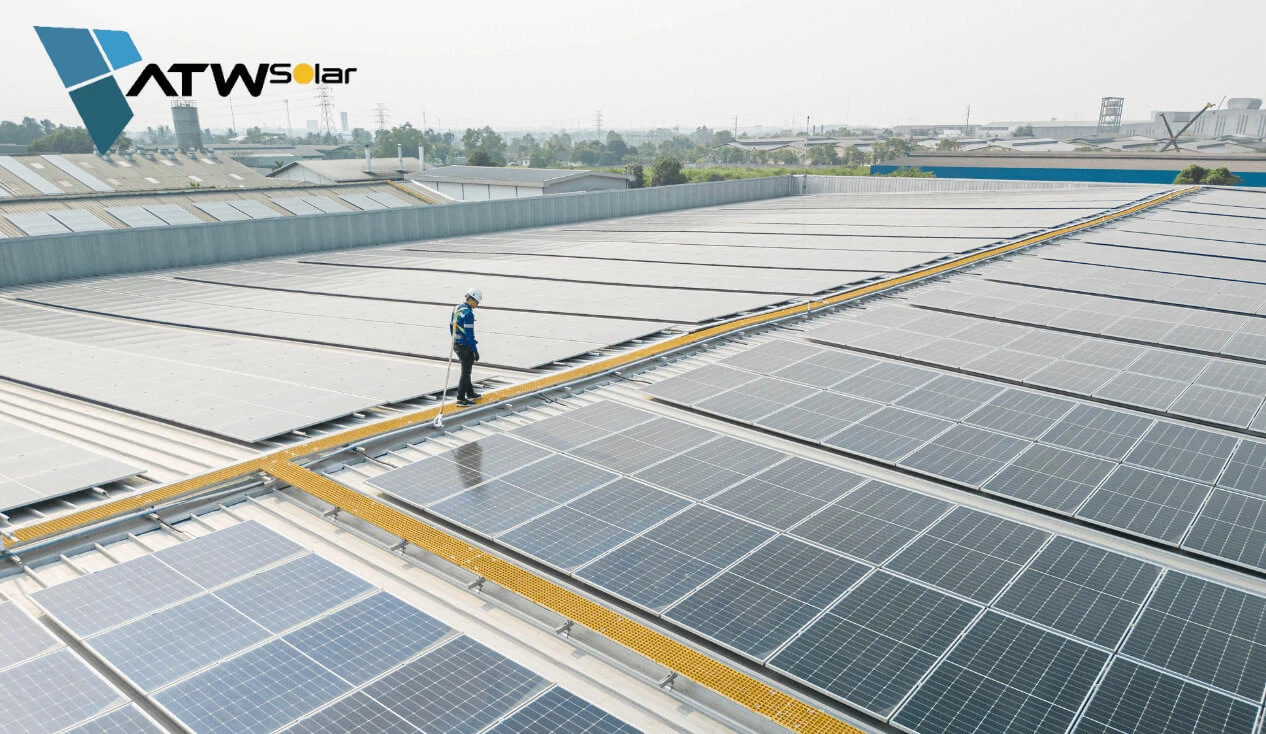
Why Is Workplace Safety So Important in the Solar Panel Industry?
The solar panel industry is experiencing rapid growth in Indonesia as more businesses and households show interest in transitioning to clean energy. This growing demand has encouraged many solar panel companies in Indonesia to provide reliable solar energy solutions. However, behind what may appear to be a straightforward solar panel installation lie various occupational hazards that require serious attention.
Implementing an Occupational Health and Safety (OHS) system is not only a legal obligation but also an ethical commitment to protecting workers’ health, safety, and productivity. Solar panel companies that effectively manage risks through OHS standards can operate more efficiently, minimize disruptions, and maintain overall project quality.
As an internationally certified solar panel company in Indonesia, ATW Solar makes OHS a fundamental part of every solar power system installation and maintenance project.
Safety Risks Faced by Solar Panel Contractors

Solar panel installation presents unique challenges, particularly due to environmental and technical factors. Understanding the main potential hazards on-site is essential to minimizing risks. The following are some of the most common hazards workers face:
a. Electrical Hazards
Solar panel systems operate on direct current (DC), which differs from the electrical systems commonly found in residential buildings. When a system is active, solar panels continue to generate electricity even when they are disconnected from the inverter. This exposes technicians to the risk of electric shock, particularly when proper power isolation procedures are not followed.
Electric shocks from solar panel systems can cause severe burns, internal injuries, and even death. To minimize these risks, workers must:
- Follow Lockout/Tagout (LOTO) procedures.
- Complete a Job Safety Analysis (JSA) before any work begins.
- Use insulated gloves and a multimeter for electrical testing.
b. Falls from Heights
Most solar panel systems are installed on rooftops, requiring workers to perform tasks at height. Falls pose a significant risk, especially when roof surfaces are slippery or sloped, or when adequate fall protection systems are not in place.
Data from Indonesia’s Ministry of Manpower indicate that falls from heights are among the three leading causes of workplace accidents in the construction sector. Therefore, technicians must take the following precautions:
- Wear a full-body harness with a double lanyard and shock absorber.
- Inspect scaffolding and ensure it has a valid green tag before use.
- Install lifelines and cover skylights.
- Complete working-at-height training and fall rescue simulations.
c. Excessive Sun Exposure
Field workers are often exposed to direct sunlight for hours, particularly during rooftop installation projects. Prolonged exposure to ultraviolet (UV) radiation and excessive heat can lead to dehydration, heat exhaustion, and heatstroke. These risks are especially significant in tropical regions such as Indonesia.
To reduce these risks, companies can implement preventive measures such as:
- Adjusting work shifts and rest periods.
- Providing drinking water, shaded areas, and UV-protective clothing.
- Conducting safety induction sessions on heat-related hazards.
The Importance of OHS in the Solar Panel Industry
In every project, whether small or large, implementing an OHS system at a solar panel contracting company is far more than a formality. It is a fundamental measure to protect everyone involved, from technicians to project supervisors.
Occupational Health and Safety (OHS) refers to a system of practices designed to prevent workplace accidents, reduce risks, and ensure that workers return home safely at the end of each day. For solar panel companies in Indonesia, OHS also demonstrates professionalism and a commitment to employee well-being.
Benefits of OHS Implementation for Solar Panel Companies in Indonesia
Consistently implementing OHS standards provides solar panel contractors with several direct benefits:
- Reducing workplace accidents: Clear procedures and adequate protective equipment help technicians work safely.
- Improving work efficiency: A safe working environment allows teams to stay focused and productive.
- Building customer confidence: Clients can feel more secure knowing that their projects are handled by professional teams that follow established safety standards.
- Protecting the company’s reputation: Solar panel companies that implement OHS demonstrate an understanding of the importance of safety and a commitment to professionalism, creating added value for customers and business partners.
OHS Standards for Solar Panel Companies in Indonesia
To maintain workplace safety in the field, solar panel companies in Indonesia must comply with applicable regulations and standards.
Applicable Workplace Safety Regulations
The Indonesian government, through the Ministry of Manpower and the Ministry of Energy and Mineral Resources (ESDM), has established regulations governing OHS implementation in the energy and construction sectors. Key regulations and guidelines include:
- Law No. 1 of 1970 on Occupational Safety.
- Minister of Manpower and Transmigration Regulation No. PER.02/MEN/1980 on Occupational Health Examinations.
- Minister of Manpower and Transmigration Regulation No. PER.01/MEN/1980 on the Installation and Maintenance of Portable Fire Extinguishers.
- Minister of Manpower and Transmigration Regulation No. PER.03/MEN/1982 on Occupational Health Services.
- Minister of Manpower Regulation No. PER.03/MEN/1982 on Reporting and Investigation of Workplace Accidents.
- Minister of Manpower Regulation No. 36 of 2016 on Occupational Safety and Health for Work at Height.
- Minister of Energy and Mineral Resources Regulation No. 38 of 2016 on Occupational Safety and Health Management Systems in the Energy and Mineral Resources Sector.
- Minister of Manpower Regulation No. 2 of 2020 on Occupational Safety and Health for Hot Work.
- Minister of Energy and Mineral Resources Regulation No. 3 of 2021 on Occupational Safety and Health in the Energy and Mineral Resources Sector.
- Minister of Manpower Regulation No. 9 of 2016 on Occupational Safety and Health for Work at Height.
- Minister of Energy and Mineral Resources Regulation No. 10 of 2021 on Electrical Safety Requirements.
- Government Regulation No. 50 of 2012 on the Implementation of Occupational Health and Safety Management Systems (SMK3).
- TKBT (High-Rise Building Work Personnel) certification, which is required for technicians installing solar panels at height.
These regulations require companies to ensure that their workers are protected through appropriate safety systems and equipment, including regular training and the use of standard-compliant personal protective equipment (PPE).
To learn more about the certification required for solar panel companies in Indonesia, read our full guide here.
International Standards for Solar Panel Installation
In addition to national regulations, ATW Solar also refers to international standards as a solar panel contractor to maintain work quality and safety, including:
- ISO 45001:2018 – The international standard for occupational health and safety management systems.
- ISO 14001:2015 – The international standard for environmental management systems.
- OSHA (Occupational Safety and Health Administration) – Guidance from the United States, particularly for work on rooftops and in open areas.
By referring to these standards, solar panel companies in Indonesia can go beyond meeting legal obligations and strengthen their credibility and competitiveness in both domestic and international markets. ATW Solar is also certified to ISO 45001:2018 and ISO 14001:2015, demonstrating that our occupational health and safety and environmental management systems meet internationally recognized standards.
A Guide to Implementing OHS in Solar Panel Installation and Maintenance

Key workplace safety measures include:
- Risk Identification: Before work begins, the team conducts a risk assessment to identify potential hazards at the worksite.
- OHS Training: All technicians undergo occupational safety training covering emergency procedures, equipment use, and safe work practices.
- Regular Supervision: Supervisors conduct routine inspections to ensure compliance with safety standards.
Personal Protective Equipment (PPE)
A professional solar panel contractor ensures that its technicians use appropriate PPE. The required PPE routinely used during fieldwork includes:
- Safety helmet: Protects the head from impact and should comply with applicable SNI or ANSI standards. Helmet colors may also indicate a technician’s role or position at the worksite.
- Safety glasses: Protect the eyes from dust, flying particles, and excessive light.
- Protective gloves: Protect the hands against potential electrical shocks and other mechanical hazards.
- Work uniform: Made from suitable materials to support comfort and safety during technical activities.
- Safety footwear: Designed to protect the feet from sharp or heavy objects and reduce the risk of slipping.
In addition to required PPE, technicians use supplementary PPE depending on the type of work and potential hazards at the site, such as:
- Full-body harness and lifeline: Used when working at height to help prevent falls.
- Face shield and mask: Required for welding and other hot-work activities, as appropriate to the hazards involved.
- Earplugs: Protect hearing in areas with high noise levels.
- Safety boots: Used on slippery, muddy, or otherwise challenging terrain.
ATW Solar’s Commitment to Workplace Safety

At ATW Solar, workplace safety is more than a set of technical procedures. It is an integral part of our work culture, embraced by everyone across the organization, from management to field technicians. We are committed to creating a safe and healthy working environment for all employees and business partners.
a. Safety as a Company Culture
We believe that safety is not just a procedure but a culture that every team member must uphold. To reinforce this commitment, we regularly conduct activities to raise awareness of the importance of workplace safety.
b. OHS Training for ATW Solar Personnel
ATW Solar provides various training programs to strengthen technicians’ competencies, including:
- General OHS Expert Certification: Formal training that equips personnel with foundational knowledge of occupational health and safety across various industrial sectors.
- Electrical OHS Expert Certification: Specialized certification for personnel handling electrical installations to ensure that work is performed in accordance with electrical safety standards.
- High-Rise Building Work Personnel (TKBT) Certification: Certification for workers performing tasks at height, including work above 1.8 meters, to help prevent fall-related accidents.
- First Aid Training, Emergency Response Simulations, and Fire Drills: Training activities designed to improve workers’ preparedness for workplace accidents and emergency situations.
- Safety Induction Programs and Daily Toolbox Meetings: Regular briefings for workers and project visitors covering potential hazards, safe work procedures, and daily safety responsibilities.
Workplace safety is a top priority in every solar panel project. By implementing rigorous OHS standards, ATW Solar strives to ensure that every technician can work safely and efficiently.
Want to ensure your solar panel project is handled by a professional team that puts safety first? Contact ATW Solar today to discuss your solar energy needs with our team!